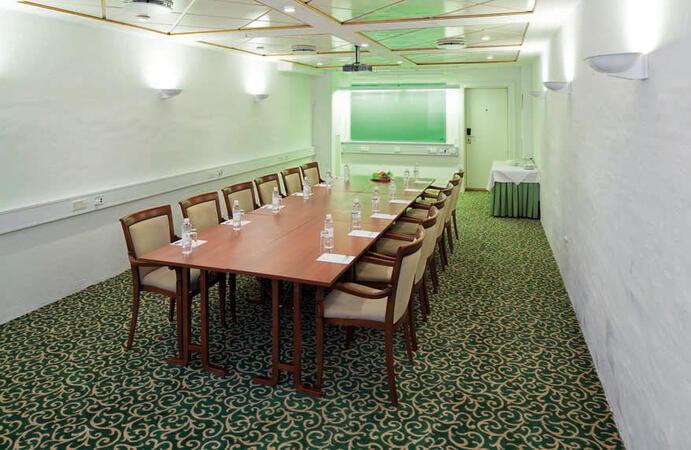
Delivered either online or on-site, these instructor-led live Infrastructure Sovereignty training courses employ interactive, hands-on exercises to demonstrate the design, construction, management, and security of independent IT infrastructure. This approach empowers organizations to assume greater control over their platforms, networks, cloud environments, and critical systems.
Infrastructure Sovereignty training is offered as "online live training" or "onsite live training". Online live training, also referred to as "remote live training", is conducted via an interactive remote desktop. Onsite live training takes place at customer premises in Copenhagen or within NobleProg's corporate training centers located in Copenhagen.
The core focus of Infrastructure Sovereignty training is developing resilient, secure, and self-managed infrastructure leveraging open technologies, private cloud platforms, virtualization, networking, automation, and contemporary infrastructure management practices.
You can also take bus 26 or 7A and get off around Vesterbros Torv; from there it is a short walk.
By bus
Useful nearby stops include:
Vesterbros Torv (Vesterbrogade) — about 1 minute from the area.
Frederiksberg Allé (Vesterbrogade) — nearby.
Trommesalen (Vesterbrogade) — nearby.
Bus 26 and 7A serve the Vesterbrogade corridor.
København, Copenhagen
NobleProg København, Bredgade 37, København K, denmark, 1260
Near Amalienborg Palace & Royal Theatre.
If you arrive by train
If you arrive at Copenhagen Central Station (København H):
Walk to København H Metro.
Take the M3 or M4 metro toward Kongens Nytorv.
Get off at Kongens Nytorv.
Walk north toward Nyhavn, then continue along Bredgade.
Bredgade 37 is about 500 m / 6 minutes' walk from Kongens Nytorv.
Another easy option
Marmorkirken (Marble Church) Metro Station is also very close to Bredgade 37. The nearby Bredgade area is about 2 minutes' walk from Marmorkirken station.
By bus
There are bus stops around Dronningens Tværgade / Bredgade, so you can also travel by bus and walk the final few minutes.
Gitea provides a lightweight, open-source, self-hosted Git solution for managing repositories, conducting code reviews, tracking issues, and integrating CI/CD. It is a growing alternative to GitHub and GitLab.com for teams prioritizing complete control over their source code, free from third-party service agreements or data export constraints.
GitLab Self-Managed provides an on-premises deployment of GitLab's full DevSecOps platform, covering source code management, CI/CD, container registry, security scanning, and monitoring. It stands as the benchmark for organizations aiming to utilize the complete GitLab feature set without depending on SaaS or allowing data to leave their internal network.
This instructor-led, live training in Copenhagen (online or on-site) targets intermediate to advanced DevOps engineers and system administrators who aim to deploy and manage self-hosted Kubernetes clusters without cloud dependencies.
By the end of this training, participants will be able to: deploy production-ready Kubernetes clusters using kubeadm on bare-metal or virtual machines; configure high-availability control planes and etcd clusters; implement container networking and storage for self-managed environments; and set up monitoring and observability using self-hosted solutions.
This live, instructor-led session—conducted either online or on-site—targets cloud professionals aiming to construct and implement multi-cloud architectures that prevent vendor lock-in and guarantee data sovereignty.
By the conclusion of this training, attendees will be proficient in identifying vendor lock-in risks, architecting portable solutions, enforcing data sovereignty controls, and harnessing cloud-agnostic tools effectively.
This instructor-led, live training in Copenhagen, offered online or on-site, is tailored for network engineers and infrastructure professionals seeking to use SONiC and ONL to deploy and manage open network infrastructure on white-box switches.
By the end of this training, participants will be able to: understand the architecture of SONiC and ONL, deploy open-source network operating systems on white-box hardware, configure essential networking features, and implement monitoring and automation solutions.
This live, instructor-led session (conducted online or on-site) is designed for system administrators and infrastructure engineers aspiring to structure, implement, and manage private OpenStack cloud infrastructure for enterprise contexts.
By the conclusion of this program, participants will possess the ability to interpret OpenStack architecture, deploy private cloud foundations, manage compute and storage assets, enforce security via Keystone, and execute enterprise best practices.
This instructor-led live training, delivered either online or onsite in Copenhagen, is designed for intermediate-level network engineers and infrastructure administrators seeking to implement software-defined networks utilizing open source tools and technologies.
Upon completing this training, participants will be equipped to design SDN architectures, implement Open vSwitch, configure FRRouting, deploy SDN controllers, and automate network management.
This instructor-led, live training in Copenhagen (online or on-site) is designed for mid-level network and infrastructure professionals seeking to utilize open-source routing, switching, Wi-Fi, and management tools to design, deploy, and operate a self-managed enterprise network.
By the end of the training, participants will be able to: design an open-source enterprise network architecture, configure routing, switching, and wireless services, enhance security and observability, and establish an operational plan for ongoing support.
This instructor-led course in Copenhagen helps intermediate engineers master Terraform for self-hosted infrastructure. Participants learn to write robust configurations, manage secure state backends, and automate bare-metal provisioning, ultimately eliminating cloud lock-in through practical labs.
Uptime Kuma is a user-friendly, self-hosted monitoring tool that oversees the availability of websites, services, and infrastructure. It serves as a viable replacement for Pingdom, Datadog Synthetics, and UptimeRobot for teams prioritizing control over their monitoring data. This instructor-led, live training—delivered online or onsite—is designed for beginner-to-intermediate SREs and DevOps engineers aiming to shift from cloud uptime monitoring to a self-hosted, sovereign status tracking platform via Uptime Kuma.
This instructor-led, live training in Copenhagen (available online or on-site) targets security engineers and system administrators seeking to deploy and manage enterprise-grade self-hosted VPN solutions using WireGuard and OpenVPN.
By the end of this training, participants will be able to deploy WireGuard and OpenVPN, design scalable architectures, integrate with identity systems, and monitor and secure VPN infrastructure.
OpenVPN and WireGuard are the preeminent open-source VPN protocols. By operating your own VPN server, you ensure that third-party providers cannot log traffic metadata, inject advertisements, or yield to foreign data requests. This training covers both protocols, catering to diverse threat models and performance needs.
Wazuh is an open-source security platform that provides unified XDR and SIEM capabilities for threat detection, integrity monitoring, incident response, and compliance. It aggregates endpoint telemetry into a self-managed analysis engine, positioning itself as a credible alternative to Splunk Enterprise Security, Microsoft Sentinel, and other cloud-native SIEMs.
Woodpecker CI is a streamlined yet powerful continuous integration engine specifically designed for self-hosted Git forges like Gitea and Forgejo. It offers a lightweight, Docker-native CI/CD experience, free from the complexity and licensing overhead of enterprise CI platforms.
This live, instructor-led training in Copenhagen (delivered online or on-site) is designed for security professionals with intermediate to advanced skills who aim to implement Zero Trust Architectures using open-source tools and sovereign infrastructure.
By the conclusion of this training, participants will be equipped to design Zero Trust architectures, deploy identity-aware proxies, implement dynamic authentication, secure microservices via service mesh, and oversee zero trust policy monitoring.
Online Infrastructure Sovereignty training in Copenhagen, training courses in Copenhagen, Weekend Infrastructure Sovereignty courses in Copenhagen, Evening Infrastructure Sovereignty training in Copenhagen, Infrastructure Sovereignty instructor-led in Copenhagen, Infrastructure Sovereignty instructor in Copenhagen, Weekend training in Copenhagen, Infrastructure Sovereignty coaching in Copenhagen, Infrastructure Sovereignty boot camp in Copenhagen, private courses in Copenhagen, Evening Infrastructure Sovereignty courses in Copenhagen, Infrastructure Sovereignty classes in Copenhagen, instructor-led in Copenhagen, Infrastructure Sovereignty on-site in Copenhagen, Online Infrastructure Sovereignty training in Copenhagen, Infrastructure Sovereignty one on one training in Copenhagen, trainer in Copenhagen